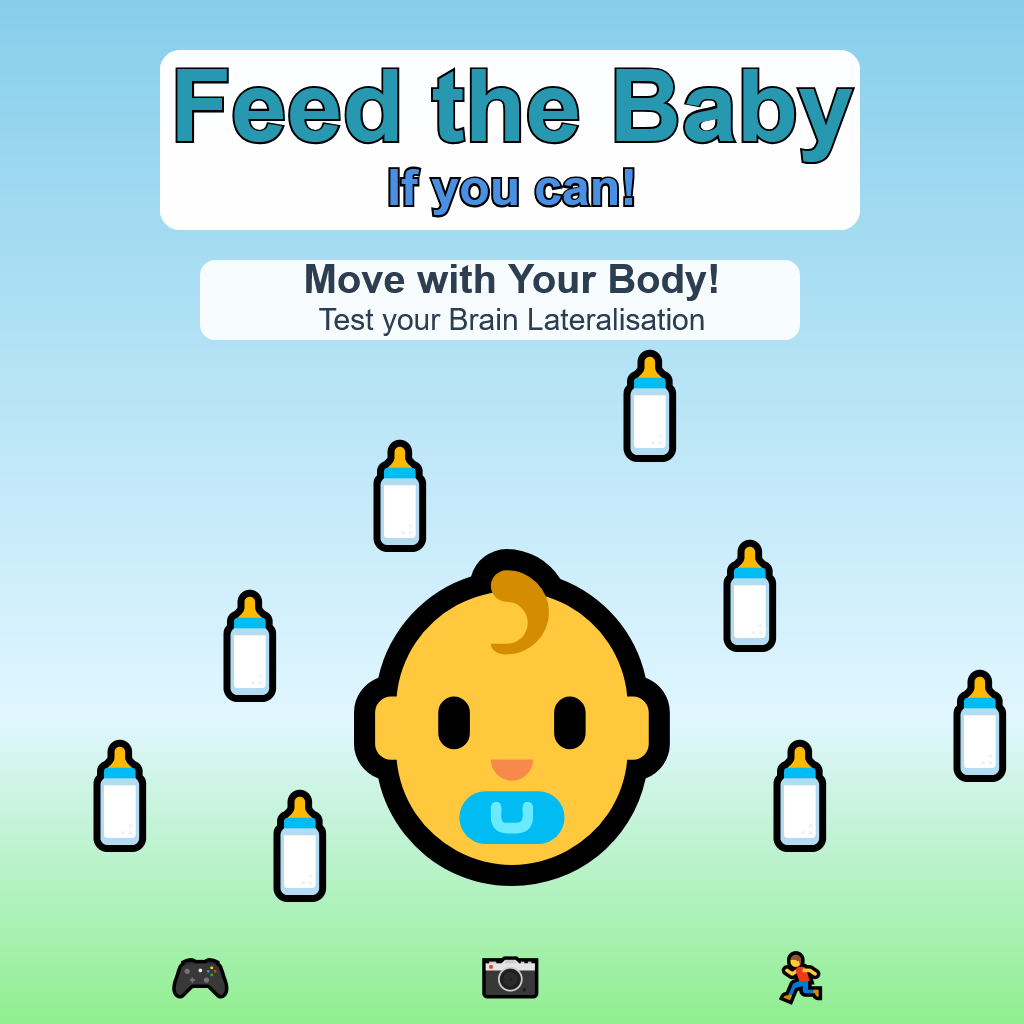
Feed the Baby: The Coordination Challenge
Description:
Step into the Motor Control Lab with Baby Bottle Catcher, a browser-based study in bimanual synchronization. Using real-time pose detection (MoveNet), this experiment challenges you to control an avatar not with a mouse or keyboard, but through the coordination of your own limbs. Your goal is simple: feed the baby. However, the control mechanism tests your proprioception and ability to dissociate or synchronize your left and right movements under time pressure.
Note:
This game runs on your browser and depends on your device resources, and your video quality. Please keep in mind that only main player should be on camera, otherwise it will conflict with the player’s body.
How to Play
Enable Your Camera: Allow the browser to access your webcam. Stand back slightly (at least 1 meter) and raise your hand so they are clearly visible in your webcam. Good lighting helps the AI track your elbows accurately.
The Controls (The Science Part):
This game maps Elbow Synchronisation to movement.
To Move RIGHT: Synchronise your arms! Make your left and right elbow angles identical (e.g., both bent at 90° or both straight).
To Move LEFT: Desynchronize! Make your elbow angles different (e.g., one arm straight, one arm bent).
Think of your body as a slider: High Sync = Right, Low Sync = Left.
Objective:
Catch the falling milk bottles 🍼 to score points.
You have 60 seconds to feed the baby as much as possible.
Avoid missing bottles to maintain a high ranking on the leaderboard.
A Bite of Science
This game improves:
- Body awareness
- Speed and precision
- Brain hemisphere coordination
How does it work?
Feed the Baby is a continuous pursuit task. Unlike the discrete actions in the other games, this requires dynamic, real-time adjustment of hand position to match a moving target. This creates a closed-loop feedback system where the brain constantly compares the hand’s position to the target and makes micro-corrections.
Physical: Promotes muscular endurance and shoulder stability. Keeping the hand elevated and tracking a target for 60 seconds builds endurance in the deltoids and rotator cuff without heavy loads.
Cognitive: Develops Visuospatial Planning and Anticipation. Players learn to predict the baby’s movement patterns, shifting from reactive tracking to predictive tracking—a higher-level cognitive skill.
Rehab Focus: Excellent for training smooth pursuit movements (coordinating eyes and hands) and building the upper-limb stamina needed for daily living tasks like grooming or eating.